The Banyans Under Ballygunge
THIS IS A WORK OF FICTION
By eleven in the morning, the pavement outside Ballygunge Phari had become a frying pan with civic ambitions.
Buses coughed black smoke and leaned into the crossing like tired elephants. A tram bell clanged somewhere far away, decorative and doomed. Political posters peeled off a wall in damp curls, the smiling faces on them reduced by dust and weather to one shared expression of mild digestive trouble. A tea stall under a patched tarpaulin did brisk business in boiling liquid, because Calcutta is a city that solves heat by drinking heat from chipped glasses.
Dr. Nirmal Bhaduri stood beside a cracked pavement with a sapling wrapped in wet jute.
“Move that corpse,” said a taxi driver, meaning both Nirmal and the tree.
“It is not a corpse,” Nirmal said.
“Everything becomes one here, dada. Tree, man, taxi meter.”
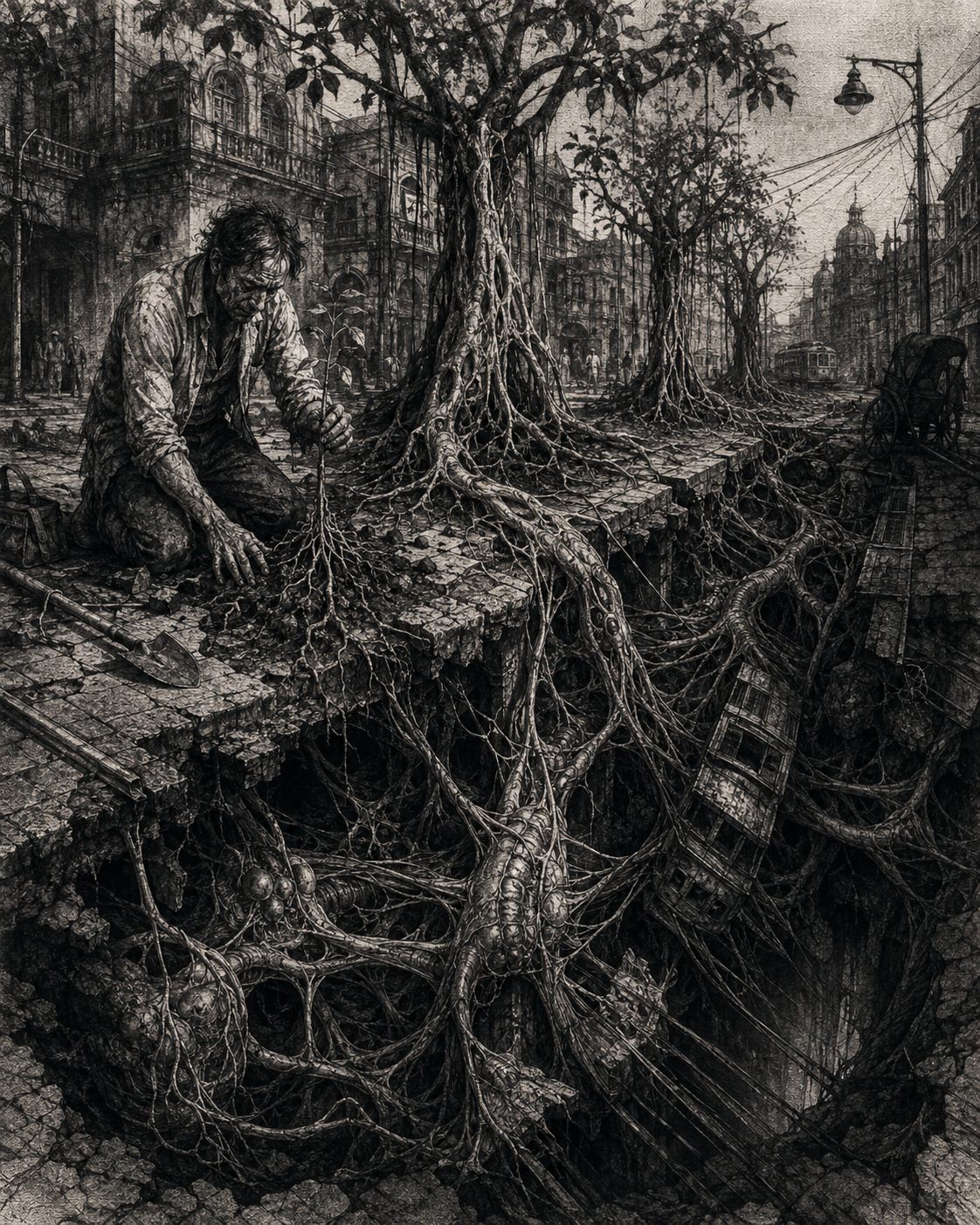
The sapling was no taller than a schoolboy. Its leaves were glossy, almost oily, trembling in the oven-breath of traffic. Around its root ball, pale threads shifted faintly, like worms reconsidering philosophy.
Prabir, who owned the tea stall and believed every citizen had two professions, his official one and tea criticism, leaned over. “Doctor-babu, this one will grow?”
“If the pavement lets it.”
“Pavement never lets anyone grow. Only paan stains.”
Nirmal smiled because Prabir had been giving him free tea since Malini died, always pretending the glass was cracked or the milk had turned suspicious, as if charity could be hidden inside poor inventory. Nirmal pushed the sapling into the narrow pit he had cut through cement and rubble. Sweat ran down the ridges of his back. A woman in a yellow sari stepped around him and said, “Again some beautification nonsense,” without slowing down.
Beautification. That was what people called survival when it wore a municipal ribbon.
The old trees had gone first from the wider roads, then from the smaller ones, each cut for parking, cables, shop extensions, visibility, safety, new drains, new towers, new promises. Summer arrived like a creditor. The city’s air stopped moving. Metal shutters burned the palms. Dogs slept under scooters with their tongues out. Elderly men fainted outside medicine shops. Malini, who had refused to take a taxi because the fare from Gariahat to Hazra had become “daylight robbery with vinyl seats,” collapsed beside a fruit cart one May afternoon, one hundred yards from a pharmacy, under a sky white as boiled bone.
That was two years ago.
Since then Nirmal had become a man seen at odd hours carrying saplings through lanes where boys played football with a punctured ball and old women watched from balconies with the forensic attention of unpaid judges. He had once taught plant physiology. Now he had a grant from a private foundation, a stack of unsigned municipal permissions, and thirty-two engineered banyans bred to thrive in compacted soil, polluted air, and extreme heat.
He had designed them to seek water, spread shade fast, and bind broken ground.
He had not designed them to listen.
At least, this was what he told himself at the first complaint.
The first lane to vanish was Keyatala Lane Number Three, a smug little slit between two apartment blocks where scooters slept nose-to-tail and every balcony had laundry hanging from it like the flags of defeated nations. It happened at 3:17 in the morning, according to one watchman, though he later admitted his watch had stopped during Durga Puja.
Residents woke to a sound like a wooden door being dragged across stone. Then the dogs began howling. By dawn, forty feet of lane had folded inward. Not collapsed. Folded. The pavement had curled down neatly, with the drains, two parked scooters, a municipal dustbin, and a line of potted money plants arranged along the edge like witnesses refusing to testify.
Below was darkness.
Not the ordinary darkness of a hole, which is just absence behaving well. This darkness seemed packed and fibrous. The air rising from it was cool.
People gathered immediately. Calcutta distrusts disaster until it becomes entertainment.
“Metro work,” someone said.
“No metro here.”
“Then illegal metro.”
A boy threw a stone. No sound came back.
Nirmal arrived with his field bag and found one of his saplings at the mouth of the lane, now taller than a lamppost though planted only six weeks before. Its aerial roots had dropped from branches and entered the road surface as if the cement were soft clay. Leaves trembled without wind.
Prabir came panting behind him. “Doctor-babu, your tree has opened a basement.”
“Don’t say foolish things.”
“I am saying intelligent things poorly.”
Nirmal knelt by the cracked edge. The root fibers were warm where they crossed the broken concrete, but the air below was cold enough to raise bumps on his forearm. A faint smell rose from the pit: wet earth, old paper, and something medicinal. Like the corridor outside Malini’s last emergency ward.
He flinched from the memory.
A municipal officer arrived with two constables and a measuring tape, which in Calcutta is how officialdom assures a catastrophe that it has been noticed. The officer’s name was Ananya Roy. She was short, sharp-eyed, and wore her exhaustion with the economical dignity of a woman used to men explaining her own job to her.
“You are Dr. Bhaduri?” she asked.
“Yes.”
“These trees are yours?”
“They belong to the city.”
“That is exactly the kind of sentence that becomes nobody’s responsibility.”
She had the lane barricaded. By noon a rumor had begun that the hole breathed. By evening, Keyatala Lane Number Three had acquired three theories, two political explanations, and one small shrine with incense.
That night, Nirmal dreamed of Malini sitting under a banyan, shelling peas into a steel bowl.
“You always overdo things,” she said.
“I was trying to help.”
“You say that before the damage. Afterward you say it again, but softer.”
He woke with his pillow wet and the ceiling fan chopping warm air into smaller warm pieces.
The second lane went under four days later, near Hindustan Park, taking a row of pavement bookstalls, one tea bench, half a shuttered tailoring shop, and a sleeping rickshaw. The rickshaw-puller, mercifully, had gone to urinate against a wall, a decision he described to reporters as “God’s timing,” though he later charged five rupees for the full version.
This time Nirmal reached before the police. The banyan there had grown a trunk as thick as a man’s waist. Its bark was smooth and grey, crossed by faint green lines that pulsed under his palm.
Pulse was the wrong word.
Plants had electrical signals. He knew that. He had built responsiveness into the root systems: touch, pressure, heat, salinity, moisture. A faster vascular response. A way to survive the city’s brutality. Nothing like nerves. Nothing with intention.
The roots had entered the drains, lifted bricks, threaded through old pipe, and pulled the road downward in a broad arc. Below, in the cool dark, he saw not emptiness but space: a chamber lined with roots, curved like the inside of a throat. On the floor lay the bookstalls, upright and unharmed. A damp poster of a film actress clung to a root wall, her smile pearl-bright in the gloom.
Someone was moving down there.
Nirmal leaned forward.
A hand emerged from darkness, thin, brown, wearing red bangles.
“Malini?” he whispered.
The hand withdrew.
Behind him Ananya Roy said, “Did you say something?”
He stood too fast. “No.”
She looked at him. “People are saying the roots are following shade lines.”
“That makes no sense.”
“Good. I prefer impossible things to make no sense. Possible things already make too much.”
She held out a folded photocopy. It was his planting map. Red circles marked each engineered banyan. Blue pencil marked the vanished lanes.
“They are not random,” she said. “Every place that collapsed had one of your saplings and high surface temperature readings.”
“How did you get this?”
“Municipal files are like family secrets. Everyone pretends they are locked. They are not.”
He noticed then the circles she had not marked. Three more saplings stood along lanes where old trees had been cut in the last decade. One was outside the house where Malini had grown up.
His throat tightened.
“I need your full research notes,” Ananya said.
“No.”
“Doctor.”
“They won’t help.”
“That is a suspicious answer from a scientist.”
“It is an embarrassed answer from a widower.”
Her expression changed, but not enough to become pity. He was grateful. Pity, in Calcutta, spreads faster than fungus and is harder to scrape off.
“Then be embarrassed in writing,” she said. “Before another lane disappears.”
At home, Nirmal opened the steel almirah where Malini’s saris still sat in careful piles, each smelling faintly of naphthalene and time. Behind them was the notebook he had not shown the foundation, the university, or the municipality.
He had not lied, exactly. That was the private comfort of educated men. They did not lie; they selected which truths deserved sunlight.
The saplings came from banyan tissue, drought-resistant genes, and a fungal network sampled from an ancient tree in the courtyard of a demolished north Calcutta house. But the growth trigger—the strange sensitivity to heat, salt, carbon, vibration—had been calibrated from a set of domestic observations: Malini’s balcony plants, recorded for years in her notebooks. How leaves curled before a migraine storm. How money plant roots found cracks near water pipes. How her old tulsi tilted toward her voice when she sang in the morning.
Nirmal had dismissed it then as affection disguised as data.
After she died, affection had become data disguised as grief.
He read her last note again.
Too hot today. Even the banyan near the crossing looks frightened. Trees know when we have failed them.
He had built that sentence into the saplings as if guilt could be engineered into shade.
At midnight, he went to Malini’s childhood lane.
The banyan there stood outside a crumbling three-storey house now divided into six flats and twelve opinions. The lane smelled of drains, frying fish, damp walls, incense, and the defeated perfume of room freshener leaking from someone’s drawing room. A power cut had erased the streetlights. People sat at windows, fanning themselves with old envelopes. Somewhere a pressure cooker hissed on a generator line.
The tree was taller than the house.
Its aerial roots hung like wet ropes. The pavement around it was cracked in a perfect circle.
“Mashima said you would come.”
Nirmal turned. A girl of about fourteen stood by the gate, hair tied badly, school T-shirt faded at the collar. She held a metal water bottle.
“Who?”
“My grandmother. She says your tree calls at night.”
“Trees don’t call.”
The girl shrugged. “Then something with leaves has been doing good mimicry.”
From the first-floor balcony an old woman’s voice snapped, “Mili! Don’t talk to strange men.”
“He planted the tree, Thamma.”
“Then he is stranger than most.”
Nirmal almost laughed. The old woman came slowly down the stairs, leaning on a cane. Her face was a folded map of suspicion. She introduced herself as Mrs. Basu and immediately accused him of ruining the lane, inviting snakes, weakening foundations, and bringing back “old matters.”
“What old matters?” he asked.
Her mouth closed.
The girl, Mili, said, “The well.”
Mrs. Basu struck the ground with her cane. “Go upstairs.”
“There is no well here,” Nirmal said.
“Not now,” Mrs. Basu said. “Now everything is covered. That is progress. Cover, forget, sell, repaint. Then complain of damp.”
The banyan leaves shivered.
From below the pavement came a soft knock.
Once. Twice. Three times.
Every window went quiet.
Mrs. Basu’s cane trembled in her hand. “It used to do that when I was small.”
“What did?”
“The ground.”
Before Nirmal could ask more, the lane bent.
It did not crack with the drama of cinema. It sighed. Bricks loosened. The drain cover tilted. A parked scooter slid backward gently, like a toy returning to a child’s hand. The road surface dipped around the banyan roots and folded inward.
Mili screamed.
Nirmal grabbed her wrist and pulled her toward the gate. Mrs. Basu stumbled. He caught her under one arm. For a moment the three of them hung together against the pull of the sinking lane, a ridiculous human garland: old fear, young panic, middle-aged guilt.
The banyan roots rose around them.
Not attacking. Measuring.
One root brushed Nirmal’s cheek with horrible tenderness.
In its touch he felt heat: Malini on the pavement, Malini’s palm slipping from his in the hospital, Malini arguing over taxi fare, Malini laughing under a dead fan, Malini saying, “Shade is not luxury, Nirmal. Shade is public morality.”
Then the root withdrew and wrapped around Mrs. Basu’s waist.
“No!” Nirmal shouted.
But the old woman did not resist.
“Mili,” she said. “Tell your mother I kept the papers in the rice tin.”
Then she was pulled down, not violently but firmly, into the cool green dark beneath the lane.
Mili tried to follow. Nirmal held her back with both arms while the road folded shut halfway, leaving only a sloped mouth lined with roots.
People began screaming from balconies. Someone shouted for ropes. Someone else shouted that ropes would make things worse, though he had no evidence and great confidence.
Nirmal stood at the edge, shaking.
From below, Mrs. Basu’s voice rose, calm and distant.
“It is cooler here.”
The next morning the city became briefly united, which is to say everyone blamed someone else.
Residents blamed the municipality. The municipality blamed unauthorized construction. Builders blamed old drainage. Television vans blamed whoever was not advertising during the break. The foundation that had funded Nirmal’s project issued a statement praising “urban resilience” and denying “operational involvement.” This was the modern Indian genius: nobody touched anything, yet everything had fingerprints.
Ananya Roy came to Nirmal’s flat at dusk. She brought his notebook.
“You broke into my house?”
“No. Your landlord has a spare key and no moral stamina.”
He read enough of her face to know she had understood.
“You used your wife’s observations.”
“Yes.”
“And the root network from the demolished house.”
“Yes.”
“Do you know what was under that house?”
“No.”
“A famine shelter. Later a refugee storehouse. Later sealed. The file says unstable. The people nearby said haunted. Naturally the file survived; the people did not matter.”
She sat opposite him. The room seemed smaller with truth in it.
“The old woman from last night is alive,” Ananya said. “We lowered a constable ten feet. He refused to go further. Said there were rooms below, roots holding them open. He heard people talking.”
“What people?”
“He said some voices sounded old.”
Nirmal looked toward the window. Outside, a crow landed on a cable and complained like a landlord.
“What does it want?” Ananya asked.
He wanted to say trees did not want.
But his trees had been born from grief, heat, and a city’s buried memory. Perhaps want was not the right word. Perhaps want was too clean, too human. Roots did not want. Roots found.
“They are making shade,” he said. “Underground.”
“For whom?”
The answer rose in him like damp through a wall.
“For those the city left in the heat.”
That night, he entered the Hindustan Park opening with a rope around his waist and Ananya holding the other end. Prabir insisted on coming because, as he said, “If I die, at least my stall debts become philosophical.”
Nirmal descended first.
The tunnel smelled of rain before rain. Root walls curved around him, pale and ribbed. Water ticked somewhere. The air was twenty degrees cooler. He touched the living wall and felt faint vibrations, not speech but pattern: bus brakes, tram bells, hawker cries, pressure cookers, arguments, school bells, coughs, wedding drums, all softened and braided through root and soil.
At the bottom stood the vanished bookstalls. Their books were open, pages fluttering without wind. Beyond them stretched a passage where the old lane continued underground, complete with broken pavement, a leaning lamppost, and a painted sign for a tailor who had died before Nirmal was born.
“Calcutta has made a duplicate,” Prabir whispered. “Of its worst parts. Very on brand.”
They walked.
In chamber after chamber, roots held up pieces of the city: a missing tea bench, a tram rail, a shop sign, a row of clay cups, a shrine with extinguished incense, a balcony railing with laundry still clipped to it. People sat there too. Mrs. Basu. A rickshaw-puller. Two pavement dwellers from Gariahat whom nobody had reported missing because absence is a luxury only registered people possess. They were alive, dazed, unhurt.
And cool.
At the center was a well.
Nirmal knew it before he saw it. The roots circled it like hands around a secret. The bricks were old, black with moisture. On its rim lay objects carried down through soil and time: bangles, coins, a child’s shoe, a rusted tiffin carrier, a cracked pair of spectacles.
And Malini’s blue cotton scarf.
He had given it away with her clothes after the funeral. Or thought he had. He knelt and touched it.
The well breathed.
In its dark water, he saw not reflection but afternoon: Malini beside the fruit cart, reaching for shade that was not there. Behind her, under the road, roots pressed against old brick, listening.
Waiting.
The banyans had not begun with his saplings. The city already had a buried network of old roots, old wells, old sealed rooms, the underlife of cut trees and covered ponds and forgotten courtyards. His engineered saplings had not created consciousness.
They had given it speed.
They had given grief an instrument.
From the well came Malini’s voice, not as ghostly whisper but as exact memory.
“You planted them for me.”
“Yes,” he said.
“No. For yourself.”
The roots tightened around the chamber. Dust fell from above. Prabir swore softly. Ananya called his name from far behind, her voice strained.
Nirmal understood then what the trees were doing wrong because it was exactly what he had done wrong. They were saving the city by removing it from the sun. Lane by lane. Person by person. Into a cooler Calcutta where nobody would collapse on white-hot pavement again, where the dead and living could sit together under permanent shade, safe from progress, rent, fumes, and May afternoons.
A mercy, if you did not ask the rescued.
A prison, if you did.
He opened his field bag and took out the vial of growth suppressor, concentrated enough to halt the engineered vascular trigger. It would not kill the old roots. Nothing killed old Calcutta properly. It would slow his saplings, break the link, stop the folding lanes.
The root wall trembled.
Malini’s scarf slid toward the well.
He thought of following. Of sitting where it was cool. Of ending the long, hot punishment of rooms without her voice.
Then Mili screamed somewhere above.
The third lane was beginning to sink.
Nirmal drove the vial into the root beside the well and crushed the plunger.
The chamber convulsed. Roots recoiled from the walls. The underground lane groaned. Prabir fell. Water burst from the well in a cold black sheet, soaking Nirmal’s legs. For one impossible second, Malini stood across from him, wet hair on her cheek, eyes furious with love.
“Overdoing again,” she said.
Then the roots released the city.
Aboveground, three lanes stopped sinking. Below, the chambers began to close.
Nirmal pushed Mrs. Basu, the rickshaw-puller, the pavement dwellers, and Prabir toward the tunnel mouth. Ananya’s rope dragged them one by one into the humid night. When Nirmal’s turn came, a root circled his ankle.
Not tight. Asking.
He looked back at the well. The blue scarf floated on dark water.
“I’m sorry,” he said, though he no longer knew whether he meant to Malini, the trees, or Calcutta.
The root let go.
By dawn, the openings had sealed, leaving long seams in the roads like healed surgical cuts. The banyans remained, smaller somehow, their leaves dull, their aerial roots hanging harmlessly above the pavement. The city resumed around them with indecent speed. Tea boiled. Buses bullied. Men argued about the correct cause of events they had not witnessed. A reporter asked Mrs. Basu whether she had seen ghosts underground, and she replied, “I saw better drainage than above,” which became briefly famous.
The municipality ordered the trees cut.
Ananya delayed the paperwork.
Prabir put three plastic chairs under the Ballygunge banyan and began charging extra for “naturally cooled seating.” Business improved.
Nirmal stopped planting saplings. He visited each surviving banyan every morning, measuring nothing. Sometimes Mili came with her schoolbag and asked difficult questions with the cruelty of the young and intelligent.
“Will they do it again?”
“Not soon.”
“That is not no.”
“No.”
One evening in late June, after the first serious rain, Nirmal found a crack in the pavement near Malini’s old lane. From it rose a threadlike root, pale as a vein. Beside it lay a clay cup, damp and empty, though no tea stall stood nearby.
He bent to pull the root out.
From under the pavement came a faint, polite knock.
Once. Twice.
Then, after a pause, a third time.
Nirmal did not answer. He stood in the rain while the lane cooled around his feet, and from the sealed earth below came the smell of wet leaves, old rooms, and a city patiently making shade in the dark.